How to (Legally) Get More Streams on Spotify
Boost Collective In-Depth Review
A Step-by-Step Strategy for Indie Artists

If you’re an independent artist or record label, you’ve probably felt the tension: you want the music to speak for itself, but the industry still watches the numbers.
Spotify streams, monthly listeners, saves, followers—these stats influence playlist opportunities, booking agents, managers, and label interest.
Like it or not, numbers matter.
So the real question becomes:
How do you grow Spotify streams in a way that’s real, legal, and actually helps your career long-term?
Not with bots. Not with fake streams. But with authentic listener growth that can feed the Spotify algorithm and build momentum.
In this guide, I’ll walk you through a practical release strategy that includes a legit playlist campaign tool called Boost Collective—the same kind of campaign I tested on my own single.
Why “Legal Streams” Are the Only Streams That Matter
There’s a shortcut that looks tempting: buying fraudulent streams.
But Spotify is more aggressive than ever in detecting fake activity, and if they flag you, your distributor can pull your music and even drop you.
It’s not worth the risk.
That’s why any growth strategy worth using has to be built around real listeners engaging with your track:
listening intentionally
saving it
adding it to their own playlists
coming back to it later
Those behaviors are what tell Spotify: this song is connecting.
The Step-By-Step Strategy
Step 1: Release Your Single Like Normal (and Let It Breathe)
When a single drops, Spotify gives it a natural early push:
Release Radar exposure
your existing followers
your email list / socials driving first-week traffic
This early spike is important because it sets the baseline for the algorithm.
In my example, the song got its initial bump from Release Radar and my normal audience, then cooled down.
Tip: Don’t panic when the curve drops after week one. That drop is normal. Your job is to plan the next wave.
Step 2: Re-Engage Your Core Audience
Before you spend any money on promotion, squeeze all the organic juice you can:
post a fresh clip or story a week after release
send a second email to your list
share a behind-the-scenes angle
ask fans to save/add to playlists
This matters because your real fans are your strongest signal to Spotify.
Tip: Frame it as inviting people into the song, not begging for streams.
Step 3: Run a Short, Legit Playlist Campaign (Boost Collective)
Once the initial wave slows, this is where a tool like Boost Collective can fit in.
Boost Collective runs campaigns by placing your single on a network of real, curated playlists with real listeners. You choose a campaign tier based on your goals and budget.
Here’s the quick process:
Grab your Spotify song link
Paste it into Boost Collective
Select your campaign tier (ex: Gold / Pro)
Checkout and let it run for ~2 weeks
That’s it. No pitching. No messaging curators. No back-and-forth.
Why this works: You’re not paying for fake streams—you’re paying for real exposure in places where your music makes sense.
Step 4: Track Results Inside Spotify for Artists
After your campaign runs for a couple weeks, head back to Spotify for Artists and look for three things:
1. The Stream Lift
My campaign created a clear bump right in the middle of October, then returned to baseline after it ended.
Boost Collective’s Pro tier claimed roughly a few thousand up to ~10k streams.
My results landed just under 6,000, which matched their estimate.
2. Listener Quality (Saves + Playlist Adds)
The best sign wasn’t just plays—it was people saving the track and adding it to their own playlists.
That’s huge algorithmically.
3. Ongoing Algorithm Momentum
When Spotify sees real listeners saving and playlisting your song, it can trigger:
Radio placements
Discover Weekly
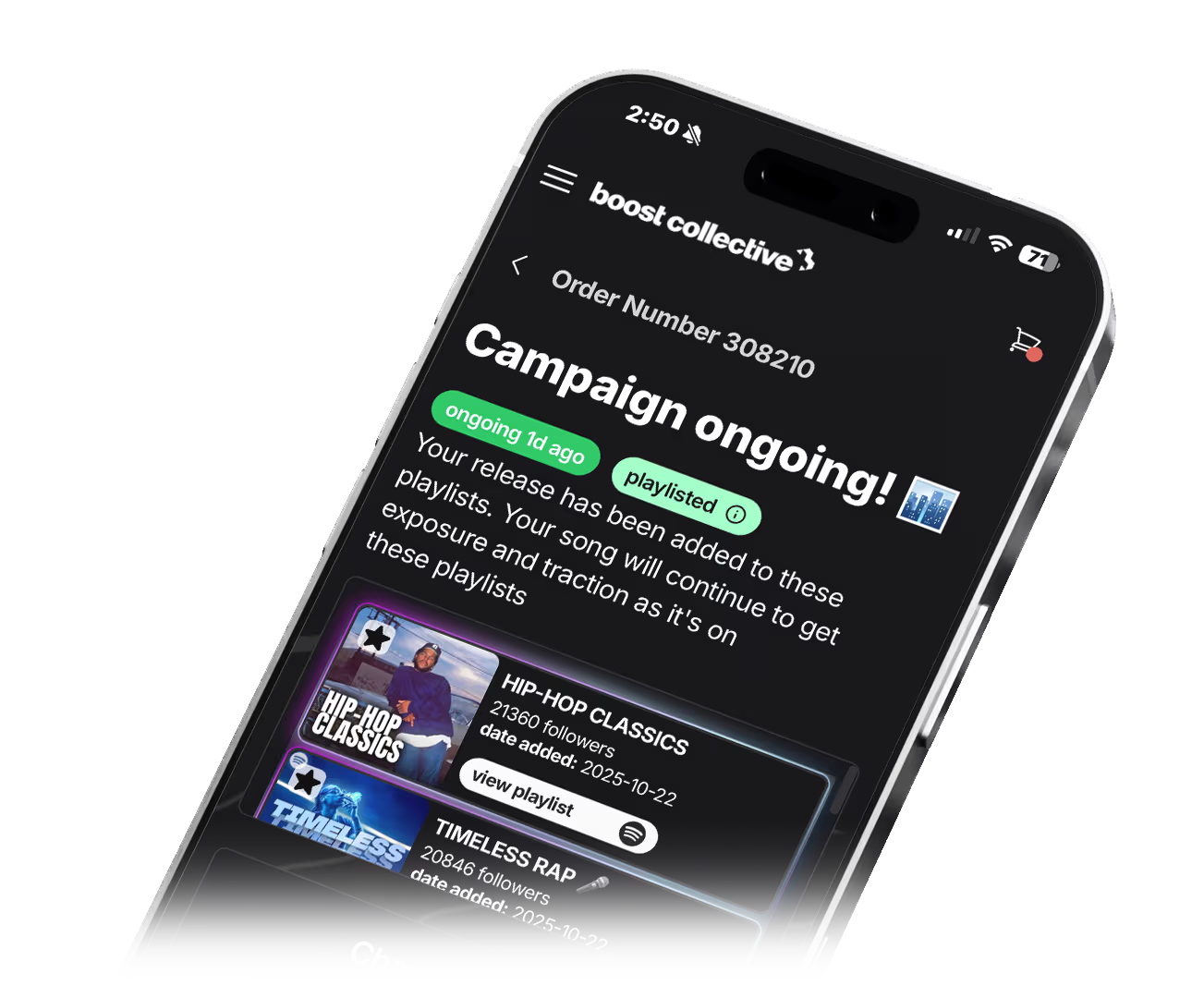

Step 5: Use the Campaign as One Part of a Bigger Release Plan
Here’s the philosophy that makes this strategy work:
A playlist campaign isn’t magic.
It’s one wave in a multi-wave release strategy.
The rhythm looks like this:
Release week push (fans + socials + Release Radar)
Week-2 re-engagement (email + content + saves)
Week-3 playlist campaign (Boost Collective)
Week-4+ secondary playlist outreach (UGC playlists, curator pitching, etc.)
That layering is what helps your track cross the threshold into Spotify’s algorithmic engine.
In my example, the song used organic release momentum first, then got a Boost Collective lift, then later landed on a user-generated playlist—each wave stacking on the last.


WATCH THIS EPISODE
and catch other videos on our YouTube Channel
Summary:
Streaming growth isn’t about gaming the system.
It’s about putting your song in front of the right people—repeatedly—until the right people start carrying it for you.
That’s what legal playlist campaigns are for.
And in that lane, Boost Collective is one of the rare tools that seems to do it the right way.

FREE
DOWNLOAD
10 STEP RELEASE PLAN

Extra Tips to Get the Most Out of Boost Collective (or Any Legit Campaign)
Tip 1: Only Promote Your Best, Most “Playlist-Ready” Single
Campaigns amplify what’s already working. Choose the track with:
strongest hook
clearest genre lane
most replay value
Tip 2: Keep Posting While the Campaign Runs
If you go silent during the boost, you waste part of the momentum.
Make sure your socials and email list are still active during those two weeks.
Tip 3: Watch for UGC Playlist Adds
When listeners pull your song into their own playlists, that’s the gold.
In my case, the “playlist adds” bump during Boost Collective was noticeably stronger than other traffic sources.
Tip 4: Avoid Anything That Smells Like Bots
If the service can’t explain where listeners are coming from, run.
Authenticity protects your catalog.

RECORD LABEL
ACADEMY
The Complete A to Z of Building and Growing an Independent Record Label.

BEST VALUE
*
BEST VALUE *
RECORD LABEL
ACADEMY
Instant Lifetime Access to all our courses, books, and templates!
Starting a record label business is exciting, but also overwhelming…
Where should you begin? What is essential and what is a waste of time?
Our courses and tools are here to help demystify the process, and to provide you with a step-by-step plan!
Included in The Record Label Academy - Premium Edition
Your “Start Here” Guide
How to Start a Record Label (Online Course)
Marketing for Record Labels (Online Course)
Profitable Record Label (Online Course)
Record Label Decision Tool (Online Course)
New Release Blueprint (Online Course)
10x Micro Courses (Sync Licensing, Music Publishing, Bandcamp Basics, Spotify Basics, Pressing Vinyl, Email Marketing, Income Generating, Social Media, Artwork + Design, Web Design)
8x Micro Books (Email Marketing, Music Publishing, Sync Licensing, Web Design, Artwork + Design, Spotify Basics, Bandcamp Basics, Pressing Vinyl)
Record Label Business Plan Template - Premium Version
How to Start a Record Label (eBook)
Marketing for Record Labels (eBook)
Why We (Still) Need Record Labels (eBook)
Don’t listen to bad advice, don’t get overwhelmed with information, and don’t waste money!
Tackle one music industry topic at a time until you’ve built a record label that is bespoke to who you are as a music curator and fan!
A record label that allows you to earn a living telling people about great music!
Let’s get started!
-
How to Start a Record Label (Online Course)
Record Label Marketing Strategies (Online Course)
Record Label Decision Tool (Online Course)
Profitable Record Label (Online Course)
All 10 Micro Courses
All 8 Micro eBooks
How to Start a Record Label (eBook)
Record Label Marketing Strategies (eBook)
Tons of bonus templates and extra resources
RECORD LABEL
ACADEMY
Instant Lifetime Access to all our courses, books, and templates!
Starting a record label business is exciting, but also overwhelming…
Where should you begin? What is essential and what is a waste of time?
Our courses and tools are here to help demystify the process, and to provide you with a step-by-step plan!
Included in The Record Label Academy - Premium Edition
Your “Start Here” Guide
How to Start a Record Label (Online Course)
Marketing for Record Labels (Online Course)
Profitable Record Label (Online Course)
Record Label Decision Tool (Online Course)
New Release Blueprint (Online Course)
10x Micro Courses (Sync Licensing, Music Publishing, Bandcamp Basics, Spotify Basics, Pressing Vinyl, Email Marketing, Income Generating, Social Media, Artwork + Design, Web Design)
8x Micro Books (Email Marketing, Music Publishing, Sync Licensing, Web Design, Artwork + Design, Spotify Basics, Bandcamp Basics, Pressing Vinyl)
Record Label Business Plan Template - Premium Version
How to Start a Record Label (eBook)
Marketing for Record Labels (eBook)
Why We (Still) Need Record Labels (eBook)
Don’t listen to bad advice, don’t get overwhelmed with information, and don’t waste money!
Tackle one music industry topic at a time until you’ve built a record label that is bespoke to who you are as a music curator and fan!
A record label that allows you to earn a living telling people about great music!
Let’s get started!
-
How to Start a Record Label (Online Course)
Record Label Marketing Strategies (Online Course)
Record Label Decision Tool (Online Course)
Profitable Record Label (Online Course)
All 10 Micro Courses
All 8 Micro eBooks
How to Start a Record Label (eBook)
Record Label Marketing Strategies (eBook)
Tons of bonus templates and extra resources
Digital Distribution
Glossary
Aggregator
Another term for a digital distributor. Aggregators collect your music, metadata, and artwork, then deliver it to multiple digital platforms (DSPs) like Spotify, Apple Music, and Amazon Music. This term is used less often now but still pops up.
Back Catalog
All previously released music owned or managed by an artist or label. In digital distribution, your back catalog can continue earning royalties long after release.
Content ID
A system used by platforms like YouTube to track and monetize copyrighted content. Some distributors help you register your music with Content ID so you can earn revenue when others use your tracks in videos.
Cover Song Licensing
If you’re distributing a cover song, you may need a mechanical license. Some distributors (like DistroKid) offer built-in licensing options for cover songs, while others require you to handle it independently.
Custom Release Date
The ability to choose the date your music goes live on streaming services. Not all distributors offer this in basic plans, so check before uploading.
Digital Service Provider (DSP)
Streaming platforms and digital stores that host and sell your music, like Spotify, Apple Music, Tidal, Amazon Music, Deezer, etc.
Distribution Fee
The cost to use a distributor. This could be a flat fee per release, an annual subscription, or a percentage of your royalties.
ISRC (International Standard Recording Code)
A unique code assigned to each track that helps identify and track plays, purchases, and royalties. Most distributors will generate ISRCs for you, but some let you bring your own.
Metadata
The information attached to your release—artist name, song title, genre, release date, label name, songwriter credits, etc. Clean metadata ensures your release is correctly listed and monetized.
Monetization
The process of earning revenue from streams, downloads, and content usage. Distributors collect this money and (hopefully) pay it out to you.
Pre-Save / Smart Link
A marketing tool that lets fans pre-save your release on platforms like Spotify. Many distributors provide these as part of their promo toolkit.
Royalty Splits
Some distributors allow you to automatically split royalties between collaborators (producers, co-writers, labels). A great tool for transparent accounting.
Streaming Royalties
The income you earn from your music being streamed. Distributors collect these royalties from DSPs and pay them out based on your agreement.
UPC (Universal Product Code)
A barcode used to identify your album or single as a product. Required for digital distribution; some distros provide one, while others charge extra.
White-Label Distribution
Private, often invite-only distribution services offered to established labels and high-performing artists, usually with exclusive tools, reps, and better placement options.
Withdrawal Threshold
The minimum amount of earnings you need to reach before you can request a payout. Varies by distributor.
YouTube Music & Content Monetization
Some distributors offer YouTube Music delivery and monetization through YouTube’s Content ID system, letting you earn when your music is used in user-generated videos.
Helpful Articles for Record Labels
-
10 Steps to Planning Your New Release
50 Reasons Why You Should Start a Record Label
How Fans Can Support Record Labels
How Many Releases Per Year is Ideal?
How to Register Your Record Label
How to Submit Your Music to Record Labels
How to UNSTUCK your record label
Leveraging the Power of Lead Time
Record Store Day
Social Media Strategies & Solutions
Social Media Strategies & Solutions
The 4 Attributes of a Great Record Label
Why Artists Need a Record Label
Why Do We Release Music on Fridays?
How to Make a Business Plan
Record Contract Template
How to Start a Record Label
Branding & Album Artwork
Releasing Music on Vinyl

Music Publishing for Labels
How to Make Cassette Tapes
Bandcamp Best Practices

Other Record Labels Podcast
Featuring interviews with…